

Best Practices in Graduate Program Structure
Graduate programs at Oklahoma State University (OSU) are diverse in size, structure, and academic focus. To promote excellence in graduate education and ensure a consistent student experience, OSU recommends a foundational organizational framework tailored to each program’s needs.
This page outlines key roles, committees, and best practices that support the success of graduate students, faculty, and administrators, while encouraging shared responsibility and academic integrity across all programs.
-
OSU Graduate Education
Graduate education at OSU functions as a collaborative system involving four key entities: the Graduate College, Graduate Faculty, individual Graduate Programs, and each Disciplinary College. These units are interdependent, working together to support graduate student success, uphold academic standards, and foster innovation across disciplines.
Each graduate program should adopt a structure that reflects its enrollment size, degree offerings, and administrative resources. The goal is to build environments in which faculty and staff can effectively support students from recruitment through graduation, while maintaining shared responsibility and accountability.
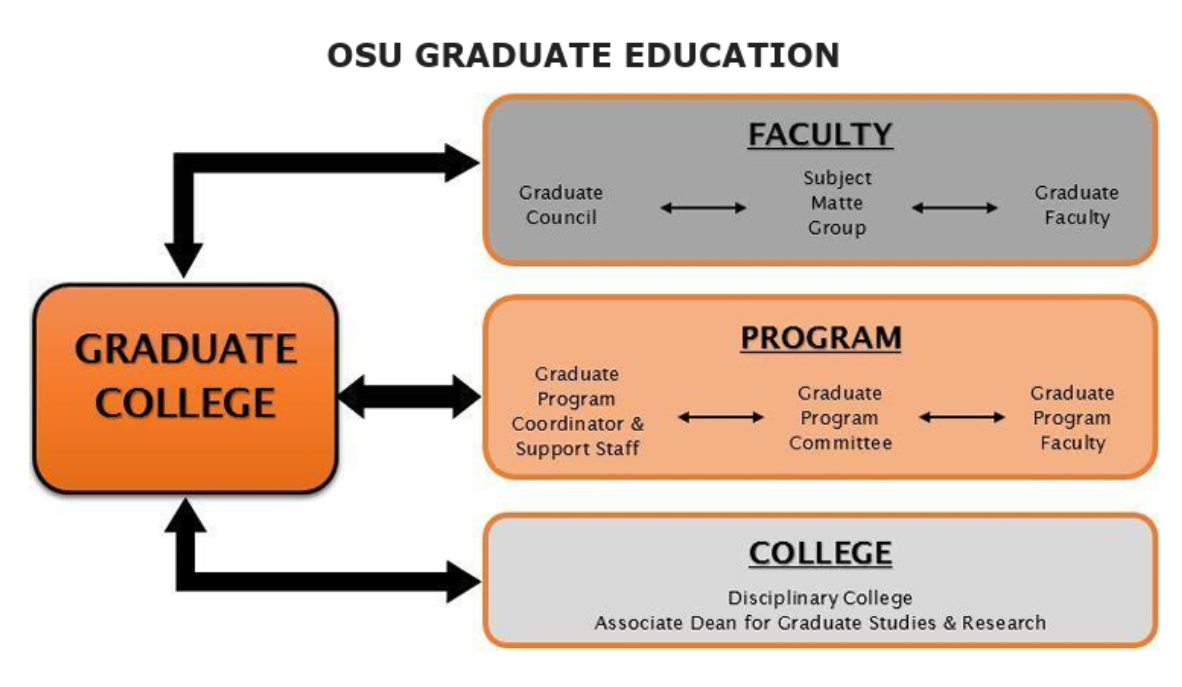
-
Graduate Program Faculty
Graduate Faculty are central to the graduate education experience at OSU. They are responsible for providing rigorous instruction, supervising research, and mentoring students in ways that support intellectual and professional growth. Their role is not limited to teaching. They help shape the academic direction of their programs and uphold the university's scholarly standards.
In many graduate programs, faculty also serve in key administrative roles, such as Graduate Program Coordinators (GPCo), members of the Graduate Program Committee (GPC), and collaborators with Graduate Program Staff (GPS). By actively participating in governance and program operations, faculty ensure that graduate education remains student-centered, inclusive, and academically sound.
-
Graduate Council
The Graduate Council is the university-wide governing body for graduate education and serves as the formal voice of the Graduate Faculty. It plays an essential role in ensuring academic quality and consistency across all graduate programs.
Established in 1948, the Council facilitates policy development, program review, and strategic planning. It operates through Subject Matter Groups, organized by discipline, that provide additional insight and representation. These groups enable OSU to coordinate complex academic decisions while preserving the disciplinary integrity of each field. The Graduate Council fosters a culture of transparency and collaboration between programs, colleges, and the Graduate College.
-
Graduate Faculty
Graduate Faculty have wide-ranging responsibilities that support the university’s mission and uphold the academic and ethical integrity of graduate education. They must:
- Develop and maintain graduate curricula aligned with disciplinary standards
- Advise students and serve on thesis or dissertation committees
- Teach graduate-level coursework and supervise scholarly projects
- Evaluate student performance and progress toward degree completion
- Participate in academic policy development and assessment initiatives
- Recommend candidates for graduation and degree conferral
Graduate Faculty are entrusted with both authority and accountability. Their active involvement ensures that each graduate program provides students with a rich, supportive academic environment.
-
Graduate Program Personnel
Graduate Program Coordinator (GPCo)
The Graduate Program Coordinator is the primary administrative leader of the graduate program. Appointed by the unit head, the GPCo is responsible for ensuring that all academic and operational aspects of the program function smoothly. These responsibilities include overseeing admissions, student advising, academic progress tracking, curriculum management, and compliance with Graduate College policies.
GPCos also serve as liaisons between the graduate program and the Graduate College. They often represent their program at coordinator meetings, training sessions, and working groups. They must be Graduate Faculty members in most cases, although rare staff appointments may be allowed with appropriate approval.
Best Practice
To maintain the integrity of shared governance, the GPCo should not simultaneously serve as the academic unit head. This separation ensures checks and balances in decision-making and prevents conflicts of interest.
Compensation and Recognition
Because GPCo duties often exceed standard faculty workloads, appropriate recognition should be provided. This may include:
- Course releases to free up time for administrative work
- Summer salary or stipends for year-round responsibilities
- A&D (Appraisal and Development) documentation of service contributions
- Consideration in promotion and tenure decisions when applicable
Untenured Faculty Consideration
If an untenured faculty member is asked to serve as GPCo, the appointment should be carefully reviewed by the dean of the disciplinary college. The role involves making decisions that may carry risk, and early-career faculty should be protected from undue burden
-
Graduate Program Committee (GPC)
The Graduate Program Committee serves as the internal governance body for the graduate program. Its main purpose is to guide academic decision-making in a collaborative and representative manner. The GPC is responsible for:
Reviewing applications and recommending admissions decisions
- Advising on curriculum revisions and program requirements
- Establishing procedures for exams, defenses, and milestones
- Evaluating student progress and resolving academic exceptions
- Mediating disputes related to graduate program policies
The GPC provides critical oversight and ensures that program policies are implemented consistently and fairly. It should function transparently, with broad faculty engagement and clear communication practices.
-
GPC Composition
The GPC should consist of at least three to five Graduate Faculty members. The structure and membership of the committee should be outlined in the program’s bylaws and reviewed regularly. In larger or interdisciplinary programs, it may be helpful to include representatives from different subdisciplines.
- An odd number of members is encouraged to avoid tie votes
- Membership should reflect diverse perspectives within the program
- The GPC chair may be the GPCo, depending on the program’s governance model
- Faculty input into committee selection is a best practice
The GPC’s work should be documented, and its decisions should be shared with the broader Graduate Faculty to ensure accountability and transparency.
-
Graduate Program Staff (GPS)
Graduate Program Staff play a vital role in supporting both students and faculty. They manage the program's day-to-day administrative functions and serve as a key point of contact for prospective and current students.
Typical responsibilities include:
- Processing admissions applications and communicating with applicants
- Scheduling exams, defenses, and committee meetings
- Managing graduate records and maintaining documentation
- Communicating deadlines, policies, and procedures
- Assisting with the thesis and dissertation submission process
- Supporting faculty in navigating Graduate College systems
GPS roles are especially important in larger programs, where consistent support and institutional memory are essential for operational success.
Best Practice
GPS personnel should receive appropriate onboarding and professional development. Their experience and reliability make them indispensable to the success of graduate education at OSU.
-
Disciplinary College Graduate Program Staff
Associate Dean for Graduate Studies and/or Research (ADR)
Each disciplinary college designates an ADR to support its graduate programs. The ADR serves as the point of contact between the college and the Graduate College and coordinates graduate education at a higher level.
Responsibilities include:
- Representing the college in university-wide graduate initiatives
- Managing funding opportunities such as fellowships and scholarships
- Convening college-level graduate program coordinators for collaboration
- Advising the Graduate College on college-specific policies or proposals
- Supporting the professional development of faculty and staff
ADRs help ensure that OSU’s graduate programs are well-aligned, well-resourced, and supported by leadership at every level.
Endorsed by the Graduate Council on April 24, 2015